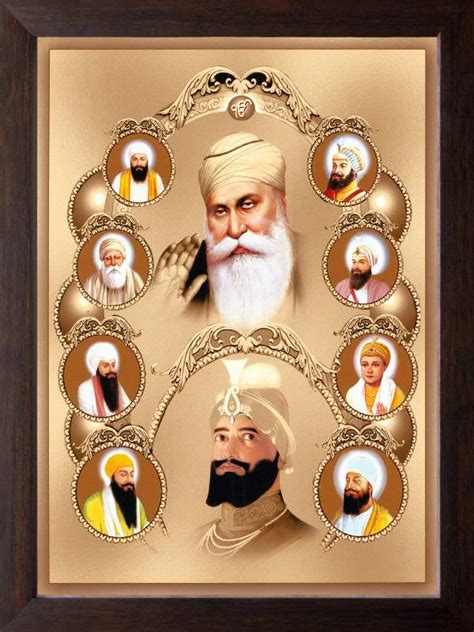
The Sikh faith, founded by Guru Nanak in the 15th century, is guided by the teachings of its ten spiritual leaders, known as the Sikh Gurus. Each Guru played a significant role in shaping the principles and practices of Sikhism, contributing to its growth and development over time. The line of Sikh Gurus began with Guru Nanak and ended with Guru Gobind Singh, who declared the Guru Granth Sahib, the holy scripture of Sikhism, as the eternal Guru of the Sikhs.
Introduction to the Sikh Gurus

The Sikh Gurus were not only spiritual leaders but also social reformers, poets, and philosophers. They preached a message of love, compassion, and equality, and their teachings emphasized the importance of devotion to one God, the rejection of superstition and blind ritual, and the pursuit of a simple and honest life. The ten Sikh Gurus are revered for their wisdom, courage, and selflessness, and their legacy continues to inspire and guide Sikhs around the world.
Key Points
- The Sikh faith was founded by Guru Nanak in the 15th century.
- There were ten Sikh Gurus, each contributing to the growth and development of Sikhism.
- The Guru Granth Sahib, the holy scripture of Sikhism, was declared as the eternal Guru of the Sikhs by Guru Gobind Singh.
- The Sikh Gurus preached a message of love, compassion, and equality, emphasizing devotion to one God and the rejection of superstition.
- The teachings of the Sikh Gurus continue to inspire and guide Sikhs around the world.
The Ten Sikh Gurus
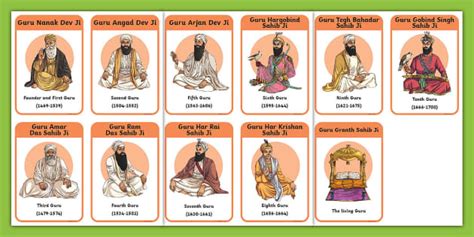
The ten Sikh Gurus are as follows:
Guru Nanak (1469-1539)
Guru Nanak, the founder of Sikhism, was born in 1469 in Talwandi, a village in present-day Pakistan. He is believed to have received a divine vision at the age of 38, which led him to preach a message of love, compassion, and equality. Guru Nanak traveled extensively, spreading his teachings and establishing a community of followers.
Guru Angad (1504-1552)
Guru Angad, the second Sikh Guru, was a devoted disciple of Guru Nanak. He was born in 1504 and succeeded Guru Nanak as the leader of the Sikh community. Guru Angad introduced the Gurmukhi script, in which the Guru Granth Sahib is written, and developed the langar, a communal kitchen where followers could gather to share meals.
Guru Amar Das (1479-1574)
Guru Amar Das, the third Sikh Guru, was born in 1479 and succeeded Guru Angad as the leader of the Sikh community. He established the city of Goindwal, which became an important center of Sikh learning and culture. Guru Amar Das also introduced the manji system, which divided the Sikh community into 22 districts for administrative purposes.
Guru Ram Das (1534-1581)
Guru Ram Das, the fourth Sikh Guru, was born in 1534 and succeeded Guru Amar Das as the leader of the Sikh community. He founded the city of Amritsar, which became the spiritual center of Sikhism, and established the sarovar, a sacred pool of water that surrounds the Golden Temple.
Guru Arjan (1563-1606)
Guru Arjan, the fifth Sikh Guru, was born in 1563 and succeeded Guru Ram Das as the leader of the Sikh community. He compiled the Adi Granth, the first version of the Guru Granth Sahib, and established the Golden Temple in Amritsar. Guru Arjan was martyred in 1606, becoming the first Sikh Guru to be executed for his faith.
Guru Hargobind (1595-1644)
Guru Hargobind, the sixth Sikh Guru, was born in 1595 and succeeded Guru Arjan as the leader of the Sikh community. He introduced the concept of miri-piri, which emphasized the importance of both spiritual and temporal power. Guru Hargobind also established the Akal Takht, the highest seat of Sikh authority, and led the Sikh community in a series of battles against the Mughal Empire.
Guru Har Rai (1630-1661)
Guru Har Rai, the seventh Sikh Guru, was born in 1630 and succeeded Guru Hargobind as the leader of the Sikh community. He played a key role in promoting peace and understanding between the Sikhs and the Mughal Empire, and established a network of missionaries to spread Sikh teachings throughout India.
Guru Har Krishan (1656-1664)
Guru Har Krishan, the eighth Sikh Guru, was born in 1656 and succeeded Guru Har Rai as the leader of the Sikh community. He became the Guru at the age of five and played a significant role in promoting Sikhism in the region of Delhi. Guru Har Krishan died of smallpox in 1664, at the age of eight.
Guru Tegh Bahadur (1621-1675)
Guru Tegh Bahadur, the ninth Sikh Guru, was born in 1621 and succeeded Guru Har Krishan as the leader of the Sikh community. He was a prolific poet and philosopher, and his teachings emphasized the importance of devotion, compassion, and selflessness. Guru Tegh Bahadur was martyred in 1675, becoming the second Sikh Guru to be executed for his faith.
Guru Gobind Singh (1666-1708)
Guru Gobind Singh, the tenth and final Sikh Guru, was born in 1666 and succeeded Guru Tegh Bahadur as the leader of the Sikh community. He played a key role in shaping the Sikh faith, introducing the Khalsa, a community of baptized Sikhs, and establishing the Five Ks, a set of symbols that Sikhs wear to signify their faith. Guru Gobind Singh declared the Guru Granth Sahib as the eternal Guru of the Sikhs, and his teachings continue to inspire and guide Sikhs around the world.
| Guru | Birth Year | Death Year |
|---|---|---|
| Guru Nanak | 1469 | 1539 |
| Guru Angad | 1504 | 1552 |
| Guru Amar Das | 1479 | 1574 |
| Guru Ram Das | 1534 | 1581 |
| Guru Arjan | 1563 | 1606 |
| Guru Hargobind | 1595 | 1644 |
| Guru Har Rai | 1630 | 1661 |
| Guru Har Krishan | 1656 | 1664 |
| Guru Tegh Bahadur | 1621 | 1675 |
| Guru Gobind Singh | 1666 | 1708 |
Who was the first Sikh Guru?
+Guru Nanak was the first Sikh Guru, born in 1469 in Talwandi, a village in present-day Pakistan.
What is the significance of the Guru Granth Sahib?
+The Guru Granth Sahib is the holy scripture of Sikhism, compiled by Guru Arjan and declared as the eternal Guru of the Sikhs by Guru Gobind Singh.
What are the Five Ks?
+The Five Ks are a set of symbols that Sikhs wear to signify their faith, introduced by Guru Gobind Singh. They include the kesh (uncut hair), kangha (a comb), kara (a steel bangle), kachera (cotton underwear), and kirpan (a sword).
What is the significance of the Khalsa?
+The Khalsa is a community of baptized Sikhs, introduced by Guru Gobind Singh. It emphasizes the importance of spiritual and temporal power, and its members are expected to uphold the principles of Sikhism and defend the faith.
What is the importance of langar in Sikhism?
+Langar, a communal kitchen where followers can gather to share meals, was introduced by Guru Angad. It emphasizes the importance of equality, compassion, and community service, and is an integral part of Sikh practice.
Meta description suggestion: “Discover the lives and teachings of the 10 Sikh Gurus, from Guru Nanak to Guru Gobind Singh, and learn about their contributions to the growth and development of Sikhism.” (149 characters)